Fertilizer International 531 Mar-Apr 2026
19 March 2026
Fertipaq – 2026 is the year of microgranular sulphur
SULPHUR FERTILIZER OPTIONS
Fertipaq – 2026 is the year of microgranular sulphur
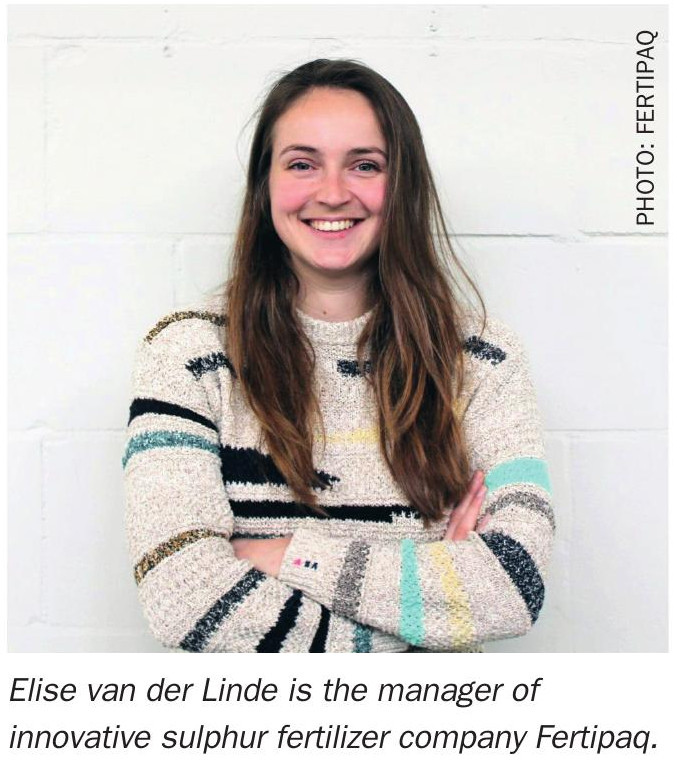
Fertilizer International recently spoke to Elise van der Linde, Fertipaq’s manager, as the company prepared to launch a new, highly-concentrated microgranular product on the market. This innovative and easy-to-disperse fertilizer contains 80% bio-sulphur.
Introduction
Netherlands-based start-up Fertipaq recovers sulphur from wastewater and biogas streams for use in fertilizer manufacture. The company was created in 2013 by Leo Habets, the winner of an in-house innovation competition at wastewater treatment company Paques.
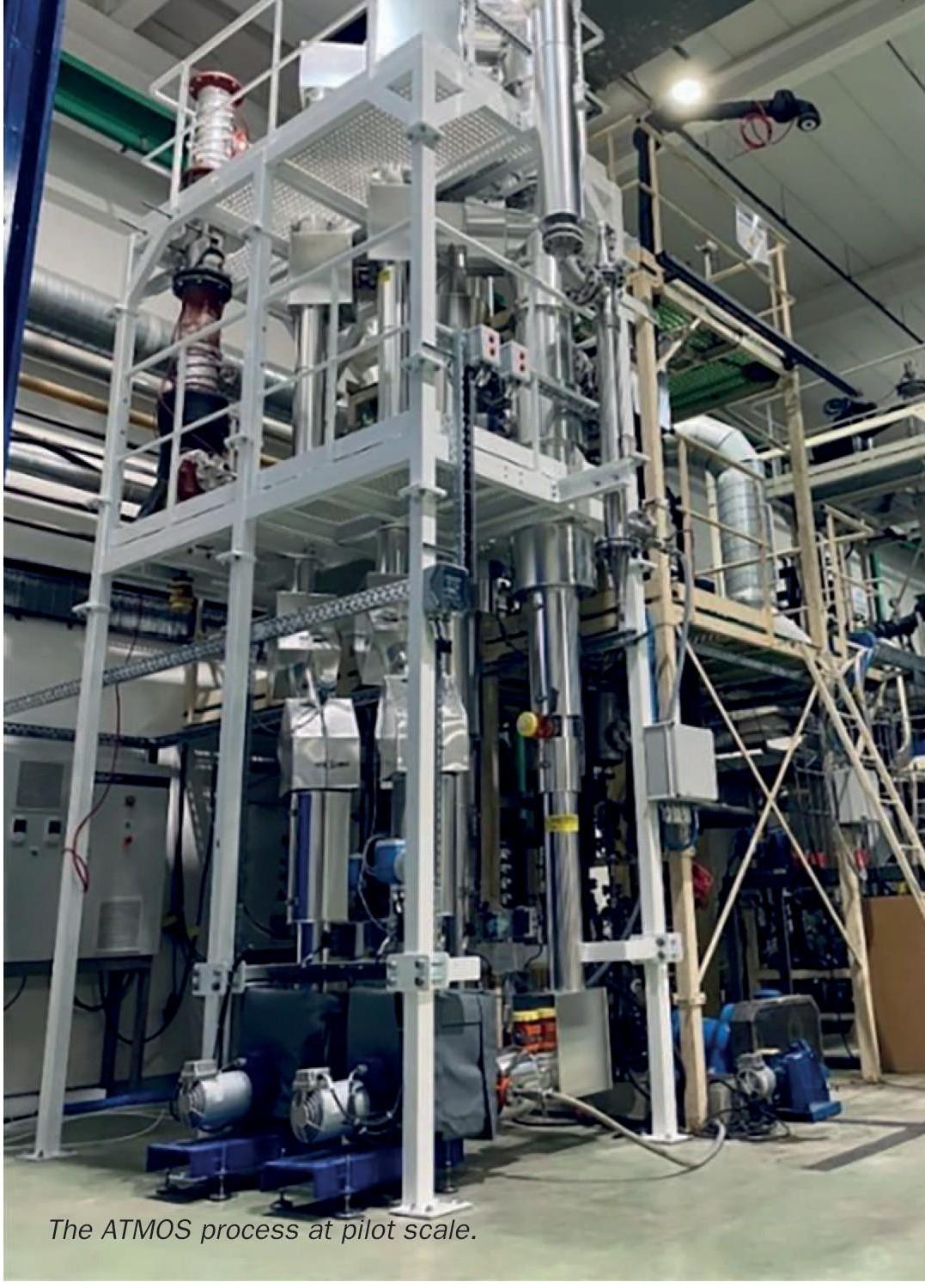
Fertipaq recovers, stabilises and reuses the organic sulphur generated by THIOPAQ® biogas desulphurisation units. THIOPAQ® technology was developed by Paques – Fertipaq’s parent company – in collaboration with universities, research institutes and industry customers. The units remove hydrogen sulphide gas (H2S) from a wide range of biogas streams (generated at anaerobic digestion plants, wastewater treatment plants and landfill sites etc.) because of equipment corrosion and health, safety and environmental reasons (Fertilizer International 520, p24).
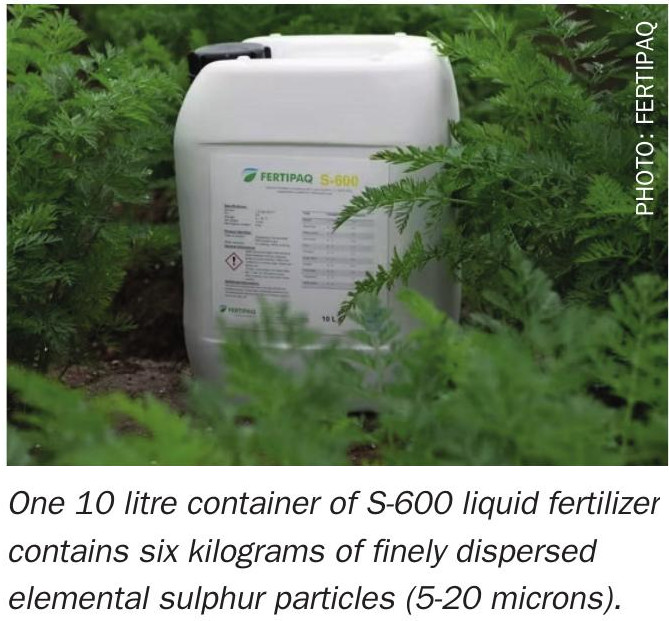
Fertipaq manufactures and markets the liquid suspension fertilizer S-600. This highly concentrated source of sulphur (600 grams per litre) is spray-applied to crops 4-5 times each season (3 litres per hectare concentration). It is ideal for crops with a high sulphur requirement and is suitable for organic farming (Fertilizer International 520, p24).
S-600 has a small particle size (5-20 microns), is naturally hydrophilic and easy to disperse. There is also evidence that it boosts nitrogen availability. The company is also placing a new higher concentration microgranular sulphur fertilizer (80% S content) on the market in 2026.
The use of recovered sulphur in fertilizer applications is likely to increase in future. The International Fertilizer Association (IFA) recently commented that:
“Hidden hunger is back. This time, it’s sulphur. Across the world’s major cropping systems, a constraint is tightening: widespread sulphur deficiency.”
The Association, which has launched a project to map this deficiency globally, specifically mentions alternative sulphur sources – such as sulphur recovered from waste streams – as a potential supply solution, especially as we decarbonise the world economy.
Fertilizer International spoke to Elise van der Linde, Fertipaq’s manager, in February about the company’s origins, its circular business model, new product launch and how recovered bio-sulphur can help address growing demand for ‘the fourth crop nutrient’.
From a winning idea to a commercial business
Fertipaq is a truly ‘circular’ business that emerged from the wastewater treatment industry and, for the fertilizer sector, has a very unusual and inspiring origin story. How did the company come into being?
“You’ve summarised it quite well in the introduction. An innovation competition within Paques provided employees with an opportunity to accelerate their knowledge and business opportunities. Leo Habets, the competition winner who started Fertipaq, was a THIOPAQ® specialist who knew all about desulphurisation, especially for the pulp and paper industry. Leo thought, okay, let’s do something with the recovered sulphur because it’s a valuable raw material that can be easily reused for fertilizer purposes.
“About 12 years ago, Leo started with the idea of reusing this valuable waste. The next milestone was learning how to re-suspend the sulphur and formulate it into a stable, high quality suspension. The density is quite high and, in general, suspensions always like to settle – and that’s no different with bio-sulphur.
“Finding the right additives to stabilise this product was a big step and took a few years of research. Different universities within the Netherlands, like Wageningen and Van Hall Larenstein, together helped formulate the product we have today.
“We’re now working with a lab researcher who’s a full-time employee and the third member of our team. She’s focusing on lab research and product development, as well as on crop trials with the University of Wageningen.
“This year, we’re actually starting to launch pilot production at one of our THIOPAQ® sources. So, instead of transporting this product to an off-site manufacturer, we’re now going to manufacture the finished product at source, where it’s recovered. This will save on transportation costs and lower the carbon footprint.
“Right now, we source our sulphur raw materials from different places in Europe, manufacture the product here and then transport it globally. But there are THIOPAQ® installations all over the world which can recover sulphur and our ideal would be to sell it where we recover it – in India, for example.
“In terms of sales, we have a sulphur cake product, we have the liquid suspension fertilizer S-600, and we’re also working on a new microgranular product. In the past, sales of the cake and the suspension were 50:50 by volume. But our sales are now mainly the finished liquid suspension product. This goes to distributors, because we sell business to business, and also to the end-user which is the farmer.
“Most of the product goes to western Europe, the Netherlands, Germany, Belgium etc, but we are expanding and now sell some suspension in Italy. The cake we mainly sell to Spain, for example, and the UK. We’re also focusing on Canada with the new microgranular product.
“The microgranular product [which contains 80% bio-sulphur] is mainly for export. It’s a great product for transport, right, as you’re transporting less water – which contributes to the carbon footprint – and more product. That’s much more efficient and cost effective compared to a suspension containing 50% water. You get a much higher nutrient density and are supplying a more concentrated amount of nutrients per kilo of product.”
Solving a problem, creating value
How does Fertipaq create organic sulphur fertilizer from wastewater – solving an equipment corrosion and health, safety and environmental problem and generating a commercial valuable product instead?
“THIOPAQ® is a desulphurisation unit. Biogas goes in and after washing clean biogas free of H2S comes out to generate renewable energy. The H2S is oxidised to sulphate during washing and eventually converted to elemental sulphur in a reactor with the help of bacteria.
“Wastewaters from all kinds of different industries need to be treated such as landfill, also the pulp and paper industry, plus food and beverage companies, as a brewery will generate wastewater. Even in oil and gas refineries, you have sour gas that needs to be treated. While you can do that with the help of the Claus process, nowadays, more refineries are changing to biological fibre installations instead.”
Bio-sulphur beings benefits
Does Fertipaq’s S-600 fertilizer, being biologically-recovered rather than chemically-derived, have advantageous properties?
“Yes, indeed bio-sulphur in S-600 does have some benefits over chemical sulphur due to its properties. The product is easy to disperse in water as it’s hydrophilic – we say it is rain-fast – and it oxidises quickly in the soil because of its small particle size.
“With the oxidation rate, you will see faster results and will need less product to get the same results. Those are definitely big benefits – and we do have crop studies that show differences between applying chemical sulphur and bio-sulphur sources.”
Launching microgranular sulphur on the market
Fertipaq has been developing a new easy-to-disperse microgranular fertilizer containing 80% bio-sulphur. Is there a clear need and a gap in the market for this product and when will it be launched?
“It’s been in the pipeline one and a half years now. We did the research, got some great results in the third quarter of 2025, have now received the first big batch of four tonnes, and are working on the organic certification for this microgranular fertilizer product as we speak.
“It works in the same way as the suspension except that it’s dispersed in the mixing tank. It disperses very, very easily because it’s hydrophilic and the particle size is very small, manufactured to beneath 10 microns, as we use wet milling and fluid bed technology.
“For us, 2026 is going to be the year of microgranular sulphur. We’re now working on launching the product in the first quarter. The first batch has arrived and we’re shipping off to customers in mid-February.
“It’s a great example of how we’ve been working to develop different kind of products with all this beautiful sulphur. This product, particularly, will be great for export as now, instead of transporting water with 45% sulphur, we can also ship 80% sulphur and fill the same container with more products. The shelf life is also two years.”
A solution to global sulphur deficiency?
Is the recovery of biological sulphur part of the supply solution needed to address widespread sulphur deficiency in the world’s major cropping systems?
“Yes, with bio-sulphur we can at least partly solve sulphur deficiency, although not everything at this point, to be honest. If you look at the scale of sulphur production from oil and gas refineries it’s huge, definitely a commodity, and we’re still on the niche side of the market.
“Paques is looking at solutions for melting bio-sulphur. This is not as easy as it is for chemical sulphur. But, if we can find the right answer, melting will allow bio-sulphur to be used and applied in different ways and demand will grow.
“For us, it’s great if the paper or food and beverage industries can recover sulphur from biogas. But for them, selling sulphur to us will be of no importance as long as the value of sulphur is low – or if legislation allows them to dispose of it in water systems.
“If the market need for sulphur becomes high enough for legislation to change, then the value of sulphur will grow, and companies will have the incentive to invest in dewatering. That would automatically mean more bio-sulphur – which now simply goes to waste – will become available.
“So, yes, bio-sulphur can at least partly solve soil sulphur deficiency. Although we are still niche, both demand and availability will grow in future.”