Fertilizer International 527 Jul-Aug 2025
7 July 2025

IFA’s Sustainable Fertilizer Academy – transforming the fertilizer industry
SUSTAINABILITY
IFA’s Sustainable Fertilizer Academy – transforming the fertilizer industry
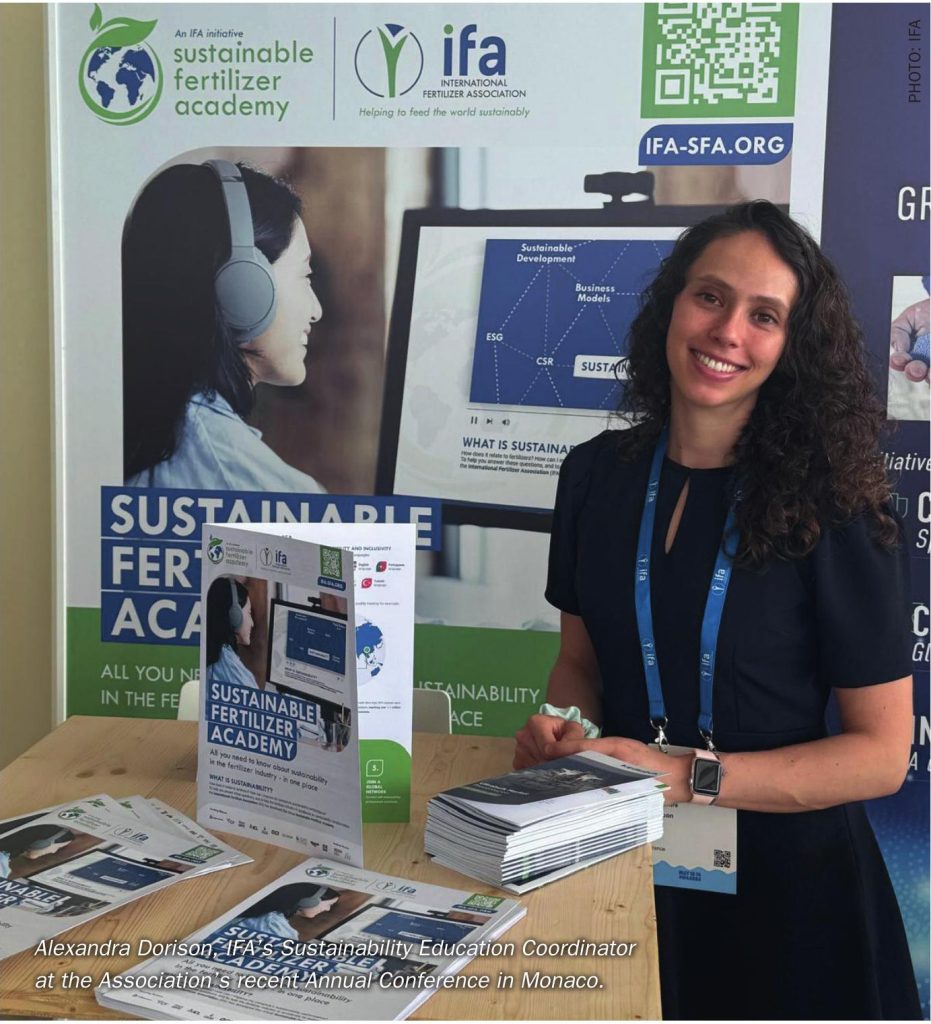
By investing in education today, the International Fertilizer Association (IFA) – through its Sustainable Fertilizer Academy (SFA) – is cultivating a technically proficient workforce that is environmentally conscious and socially engaged. In doing so, the academy is helping to implement a more sustainable future for agriculture and the fertilizer industry. The SFA’s Alexandra Dorison highlights its success and rapid progress to date.
An academy open to all
As the fertilizer industry faces increasing sustainability expectations, the need for knowledgeable, forward-thinking professionals has never been greater. Addressing climate change, enhancing nutrient stewardship, and reducing environmental impact all hinge on the skills and commitment of the people driving the sector forward.
The International Fertilizer Association (IFA) and its Sustainable Fertilizer Academy (SFA) – a virtual education platform dedicated to equipping current and future professionals – provides the tools and insights needed to lead the industry’s sustainability transformation.
Founded in September 2022 (Fertilizer International 514, p17) and now in its third year, the SFA has become a pillar of IFA’s strategy to build sustainability competencies across the global fertilizer industry. Through its e-learning platform, the Academy provides structured, multilingual training on topics ranging from fertilizer fundamentals to advanced sustainability practices. It supports workforce development in companies while also extending its reach to young professionals and students through university partnerships. The SFA is open to all learners, not only IFA members – inviting anyone interested in sustainability in the fertilizer sector to participate.

Tailored learning
The SFA offers two distinct learning levels, tailored to meet the diverse needs of learners within and beyond the industry. Level 1 introduces foundational concepts such as the basics of fertilizers and sustainability frameworks. Level 2 delves deeper into more specialised areas, including emissions reduction, circular economy principles, biodiversity impact, and nutrient stewardship.
Classes are delivered through an engaging e-learning platform, and subtitles are available in Arabic, English, Portuguese, Spanish, and Turkish, making the content accessible to a broad audience. The use of a ‘Company Access’ model also enables IFA’s member organisations to integrate SFA learning into their internal training systems, helping build sustainability competencies across teams.
Truly global
What distinguishes the SFA is its commitment to reaching learners not just in corporate offices, but also in classrooms and rural training centres around the world. In Brazil, for example, the Academy has partnered with the Federal University of Mato Grosso (UFMT) and, in its second year, has enrolled over 1,600 learners in their collaborative programme. This partnership model exemplifies the SFA’s goal of expanding its reach both geographically and demographically, while working alongside local universities and government institutions to integrate sustainability into their education.
In West Africa, through a partnership with the West African Fertilizer Association (WAFA), the SFA has educated over 1,000 agronomy students across nine universities in Nigeria, Liberia, and the Ivory Coast. Using a hybrid approach, students participate in workshops led by trained WAFA facilitators who present SFA content in on-site sessions. This approach not only accommodates areas with limited internet connectivity but also fosters discussion, mentorship, and peer-to-peer learning – critical components for building a community of practice around sustainable fertilizer use.

Training the industry’s next generation
By equipping students with essential knowledge early in their careers, the Academy ensures that the next generation of agronomists and industry professionals enter the workforce with a deep understanding of the environmental and social dimensions of fertilizer use and production.
Moreover, these efforts help address a pressing concern across the fertilizer industry, such as talent attraction and retention. Young professionals today are driven not only by career opportunities, but also by values. They seek employers whose missions align with their own commitment to sustainability. By engaging with students through the SFA, IFA is positioning the fertilizer industry as a pathway to an exciting, purposeful career.
Upgraded access
A major redesign of the Academy’s website is currently underway to improve the user experience, with a special emphasis on mobile-friendly, micro-learning formats. This will allow audiences, especially those in low-bandwidth or remote areas, to access key insights without needing a desktop computer or high-speed internet.
Additionally, the Academy is preparing to launch a new initiative of executive training modules designed for senior leaders within the fertilizer industry. These in-person sessions will tackle complex strategic issues such as climate transition planning and sustainability reporting, topics that are increasingly shaping corporate decision-making.
More to come…
The SFA’s next steps are to continue expanding its impact by developing educational content specifically for farmers, further extending its reach and relevance to those working directly on the ground.
The impact of the SFA is rooted in its existing and upcoming collaborations. Whether with universities, regional associations like WAFA, or digital innovators such as Sino-Agri, the Academy thrives on these partnerships. The Academy’s mission to empower the people who will drive the fertilizer industry’s transformation toward sustainability remains steadfast.
By investing in education today, IFA, its members, and universities are cultivating a workforce that is not only technically proficient but also environmentally conscious and socially engaged. In doing so, the SFA is helping to implement a more sustainable future, for agriculture, for the fertilizer industry, and for the planet.