
Brazil’s nitrogen industry
Brazil is the main centre for new nitrogen demand in Latin America, but in spite of major oil and gas discoveries in the 2000s, has failed to develop a downstream nitrogen fertilizer industry.

Brazil is the main centre for new nitrogen demand in Latin America, but in spite of major oil and gas discoveries in the 2000s, has failed to develop a downstream nitrogen fertilizer industry.

Liquid ammonia is one of the feeds to the urea plant. It typically comes from the ammonia plant at a pressure of about 20 bar. In the urea plant this liquid ammonia is further pumped up to synthesis pressure conditions, sometimes after passing through a buffer tank, a heater and/or a filter. According to the ammonia phase diagram, when liquid ammonia flashes to atmospheric pressure temperatures can drop to as low as -33°C under worst case conditions. In case one or more of the above mentioned items of equipment needs to be drained for maintenance, a decision needs to be made where to drain this liquid ammonia. In a urea plant the options are the ammonia water tank or the vent stack, but which is best option?

The theme of the 26th Arab Fertilizer Association Annual Fertilizer Forum & Exhibition is ‘Reshaping the industry future’. This year’s Forum will be held at the Semiramis Intercontinental, Cairo, 11-13 February 2020. New AFA Secretary General, Raed Soub , provides a preview of what is the Arab region’s showcase annual fertilizer event.
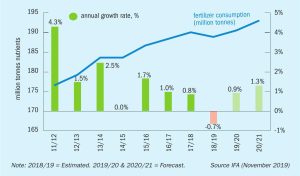
We look ahead at fertilizer industry prospects for the next 12 months, including supply and demand growth, and explore the key agricultural, macroeconomic and geopolitical drivers likely to shape the market during 2020.
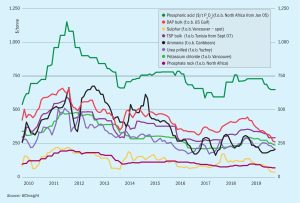
Market Insight courtesy of Argus Media
A discussion on the effect of vacuum pressure issues on the moisture content of urea prills. As the absolute pressure increases (lower vacuum) the urea melt concentration decreases in concentration (water content % increases). However there are also other causes of high moisture content in the urea melt as mentioned in this discussion.
One of the most important control parameters in urea plant operation is the synthesis pressure and a sharp increase of this pressure is very dangerous for the urea plant. One cause for an increase of the synthesis pressure is oil contamination in the urea process which causes many abnormal variations in many sections of the plant. This problem can be recognised by taking a sample from the ammonia feed and observing the colour change of the urea product. These samples and observations can prevent much confusion in determining the cause of the problem.
Heat exchanger tubes in heaters in a urea plant such as the high pressure stripper and medium pressure and low pressure recirculation heaters typically suffer from process-side fouling. This discussion looks at best ways to clean these heaters.
The main reasons for the installation of high efficiency trays (HET) in a urea reactor are: 1) to improve the redistribution of unreacted carbon dioxide inside the liquid phase rich in free ammonia, 2) to reduce the back mixing phenomena due to the density increase of carbamate and urea solution from the bottom to the top of the reactor and 3) to reduce channelling which has a negative effect on the solution residence time.
Vertical one pass (VOP) heat exchangers are commonly applied in urea plants. As the residence time in these heat exchangers is small, unwanted side reactions like biuret formation and hydrolysis of urea are limited. However, some phenomena can limit or reduce the performance of these heat exchangers e.g. bad distribution of the the inlet liquid/gas mixture over the tubes.