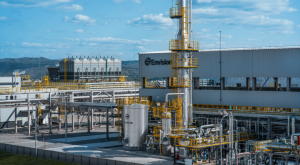
Sustainability in the fertilizer industry: pathways to decarbonisation
Industry viewpoint: Dr MP Sukumaran Nair of the Centre for Green Technology & Management (CGTM) reviews the fertilizer industry's decarbonisation options.


Industry viewpoint: Dr MP Sukumaran Nair of the Centre for Green Technology & Management (CGTM) reviews the fertilizer industry's decarbonisation options.
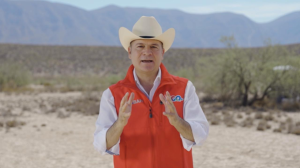
Mexico’s Fermachem is moving ahead with a large nitrogen fertilizer plant in Lerdo, Durango, backed by federal and state authorities and positioned as one of the largest industrial investments in the state.
Cefic has sharpened its warning over the EU’s Emissions Trading System (ETS), saying the European Commission’s July revision proposal could accelerate deindustrialisation despite including some of the changes industry had asked for.

Pampa Energía has taken final investment decision on its long trailed Bahía Blanca fertilizer complex, confirming a $2.7 billion granular urea project that will host Latin America’s largest urea plant by production capacity.
The signing of a memorandum of understanding between the United States and Iran on June 17th has provided relief across most markets as both sides agreed to allow ships to transit the Strait of Hormuz, at least in terms of trapped vessels from the Gulf being able to exit.
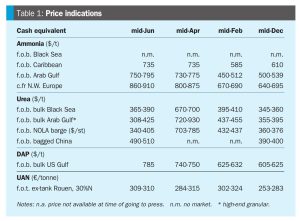
Ammonia values have continued to ease across most regions at the end of June, as the first ammonia vessels begin to exit the Gulf since the Iranian conflict began. Iranian ammonia had also begun to flow to India following the US Treasury’s issuance of a 60-day sanctions waiver on 22 June, allowing dollar-denominated trade in Iranian petrochemical products through 21 August. As a result, Indian bids have been heard as low as $750/t c.fr, as buyers benefit from a widening pool of available supply - Iranian, Chinese and renewed Southeast Asian material are all competing for the same business.
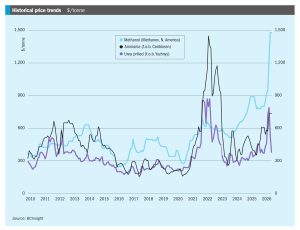
• Ammonia prices are expected to maintain their current downward trajectory, with the pace of correction likely to accelerate as the supply picture improves. Confirmed trades at materially lower levels remain limited, but the direction of sentiment is clearly softer.
Petrobras PBR has said that it plans to restart construction of the long-delayed UFN-III fertilizer plant in Três Lagoas, Mato Grosso do Sul, with work at the site expected to resume by September. UFN-III, with a planned capacity of 2,200 t/d of ammonia and 3,600 t/d of urea, was partially completed in the 2010s, but the site has been inactive and unfinished since 2015. Petrobras now intends to complete the project with an estimated investment of $1 billion, targeting commercial operations by 2029. The site was chosen as it was strategically positioned near several of Brazil’s largest agribusiness regions, including Mato Grosso, Mato Grosso do Sul, Goiás, Paraná and São Paulo.
The government of Kazakhstan says that the country will build its first ammonia-urea plant at Aktau, in the Mangistau region, with a total investment cost put at $1.6 billion.The Kazakh Industry and Construction Ministry and KazAzot PRIME have signed an investment agreement for the construction of the complex, with commissioning scheduled for 2030. Plant capacity is expected to be 660,000 t/a of ammonia, 580,000 t/a of urea and 500,000 t/a of ammonium nitrate. The government says that the plant will reduce import dependence, supply domestic farmers, and strengthen export potential. By 2030, Kazakhstan’s ammonia production capacity is projected to reach 2.3 million t/a, ensuring self-sufficiency and export growth.
Sabic is expected to make a final investment decision (FID) soon on construction of a seventh ammonia-urea plant, at Jubail Industrial City, according to local press reports. The new plant is expected to produce 1.2 million t/a of gas-based ammonia and 2.6 million t/a of urea. Feedstock allocation for the plant was approved by the Ministry of Energy in March. However, plans reportedly remain dependent on securing a long-term offtake agreement.