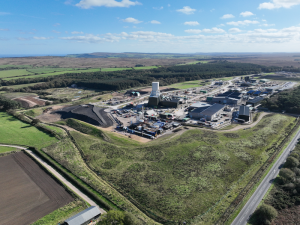
Mitsubishi invests in Woodsmith polyhalite mine
Mitsubishi Corporation has invested an undisclosed sum in Anglo American’s under-construction Woodsmith polyhalite mine in the UK.


Mitsubishi Corporation has invested an undisclosed sum in Anglo American’s under-construction Woodsmith polyhalite mine in the UK.
The promise of a global green hydrogen economy is immense, but its realization is hindered by a fundamental challenge: the monumental task of building the necessary infrastructure for production, storage, and transport.
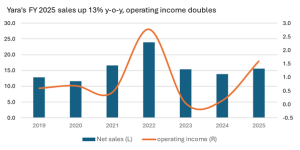
Yara’s full-year earnings (EBITDA) surged to $2.75bn in 2025, driven by stronger nitrogen margins, lower fixed costs and solid volumes.

Grupa Azoty has dismissed its CEO Andrzej Skolmowski after less than one year in the role.
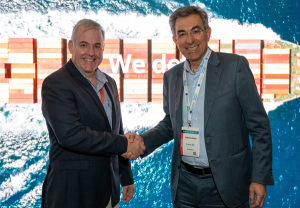
Casale and Paralloy Group have signed a strategic Memorandum of Understanding (MoU) at the recent CRU Nitrogen+Syngas 2026 Conference in Barcelona to jointly commercialise ...

EU Executive Vice‑President Stéphane Séjourné published an op‑ed calling for tying European public funding to companies that commit a substantial share of production to the EU. The piece, syndicated in several major outlets including Handelsblatt on 2 February 2026, was presented as a call signed by 1,141 European business and union leaders. “Whenever European public […]
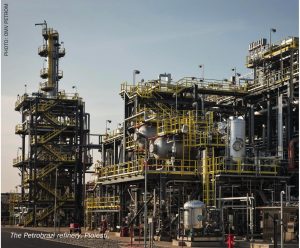
Romanian oil and gas group OMV Petrom has commissioned a new sulphur recovery unit at its Petrobrazi refinery, near the southern city of Ploiesti. Development work on the new SRU began in 2023, and represents the second at the site, treating acid gas produced during the refining process. The euro 45 million investment is part of euro 2 billion of improvements that have been made over the past 20 years as part of the company’s strategy to modernise its refining capabilities, aiming to reduce environmental impact. Last year, the company said it would invest around euro 750 million to build several sustainable fuel plants at the refinery, which are expected to become operational in 2028.

Ecovyst Inc, a provider of sulphuric acid, sulphuric acid regeneration services and catalyst activation services, has announced today that it has completed the sale of its Advanced Materials & Catalysts segment to Technip Energies. The company expects net proceeds after taxes and transaction expenses to be approximately $530 million.

Three German subsidiaries of the Belgian chemical group DOMO Chemicals have filed for insolvency, following weak demand in the European chemicals sector, high energy costs and a significant increase in imports of polyamide resins from outside the European Union, in particular from China. Court appointed administrator Prof. Lucas F. Flöther said that day-to-day operations would continue for the time being. Around 585 employees are affected across the three companies; DOMO Chemicals GmbH and DOMO Caproleuna GmbH in Leuna and DOMO Engineering Plastics GmbH in Premnitz.

Johnson Matthey (JM) has officially opened its first hydrogen internal combustion engine facility, where emission control systems will be tested. Hydrogen internal combustion engines use zero carbon hydrogen fuel in tried-and-tested engine technology, presenting a viable path for decarbonising medium and heavy-duty transport, such as trucks and buses.