• Skip to main content

    Category: Africa

    Dangote to fund new urea plant

    Aliko Dangote, self styled “Africa’s richest man”, has signed a $2.5 billion partnership with the Ethiopian Government to build one of the world’s largest single-site fertiliser plants in Gode, Somali Regional State. The was signed on August 28th by Dangote Group and Ethiopian Investment Holdings, the government’s strategic investment arm. Under the agreement, Dangote Group will hold a controlling 60% equity share, with EIH taking the remaining 40%. EIH says that the facility will be “among the top five largest urea production complexes globally… with production facilities boasting a combined capacity of up to three million metric tons per annum.” The project will take gas feedstock via pipeline from the Calub and Hilala gas fields, with provisions for future expansions into ammonia-based fertilisers.

    Green ammonia project proposal

    The Namibian mining town of Arandis is reportedly in discussions with Cleanergy Solutions Namibia concerning a $2.85 billion investment to develop a large-scale green ammonia production site at Aran-dis, targeting production of 200,000 t/a of ammonia in the first phase based on abundant local solar energy. The Aran-dis Town Council approved the project in 2024 and is in the process of acquiring 2,400 hectares of land for the project, which is subject to the award of an Environmental Clearance Certificate, expected in the second quarter of 2026. The construction phase of the project will begin in 4Q 2026, with operations due to begin in 2030. Local infrastructure development will include pipelines and storage tanks for water, hydrogen and ammonia, as well as port, railway, road and power infrastructure, and may include handling and storage facilities. Cleanergy Solutions is a joint venture between Olthaver & List and Belgian company, CMB.TECH. It has operated a green hydrogen pilot project near Walvis Bay since 2024.

    Coal based fertilizer and methanol plant proposal

    Suiso, a South African company specialising in blue ammonia production, is set to invest $1.7 billion in a coal-to-fertiliser facility in Kriel, Mpumalanga in the east of South Africa. The proposal is for a 1.5 million t/a ‘blue’ ammonia-urea plant which will replace South Africa’s annual imports of 1.2 million t/a of urea, as well as producing 235,000 t/a of blue methanol for fuels, using advanced decarbonisation and carbon capture technologies. Suiso is partnering with Sinopec Ningbo Engineering, Stamicarbon, and ETG – the latter will distribute Suiso’s fertilisers across Africa, supporting local agriculture and long-term food security.

    New phosphoric acid plant

    Egypt’s Minister of Petroleum and Mineral Resources, Karim Badawi and New Valley Governor, Mohamed Al-Zamlout were present at the signing of a framework agreement between a consortium of Egyptian public companies to build a new phosphoric acid plant at Abu Tartour in the New Valley region. The project aims to maximise added value and increasing the economic return on Egyptian phosphate ore by using it in higher-yield industries rather than exporting it as a raw material. The Egyptian state-owned consortium includes Abu Qir Fertilizers; East Gas Company, Mineral Resources and Mining Industries Authority; Misr Phosphate, AT-PHOS, Petroleum Projects and Technical Consultations Company (PETROJET), and Engineering for the Petroleum and Process Industries (ENPPI), all of which are shareholders in the project. The contractor agreement was signed with a Chinese consortium of China State Construction Engineering Corporation (CSCEC) and East China Engineering Science and Technology Co (ECEC).

    Sonatrach awards Saipem phosphate project FEED contract

    Saipem has won a front-end engineering design (FEED) contract from Sonatrach for an integrated phosphate fertilizer project in Algeria. The contract was awarded through a dual competitive process, enabling the design work to be conducted by both Saipem and a competitor company. Sonatrach will assess and compare the two FEED options from both parties, select the best technical and economic design, and then proceed with the direct award of an engineering, procurement and construction (EPC) contract to execute the project.

    OCP certifies low cadmium phosphates

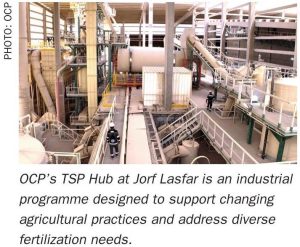
    OCP Nutricrops has received a certification that its customised phosphate fertilizers, developed specifically for the European market, meet the EU’s stringent low cadmium content requirements. The certified fertilizers contain less than 20 milligrams of cadmium per kilogram of phosphorus pentoxide (P2 O5 ), far below the European Union’s regulatory ceiling of 60 mg/kg. OCP Nutricrops says that it plans to expand this low-cadmium benchmark across all its fertilizer products worldwide by the end of 2025. Reducing cadmium in agricultural fertilizers is considered a public health priority across Europe. This initiative is closely aligned with EU goals to mitigate food-related health risks and safeguard ecosystems from harmful contaminants.