Fertilizer International 531 Mar-Apr 2026
20 March 2026
Meeting sustainable growth in fertilizer demand with CASALE technology
PHOSPHATES & POTASH INNOVATION
Meeting sustainable growth in fertilizer demand with CASALE technology
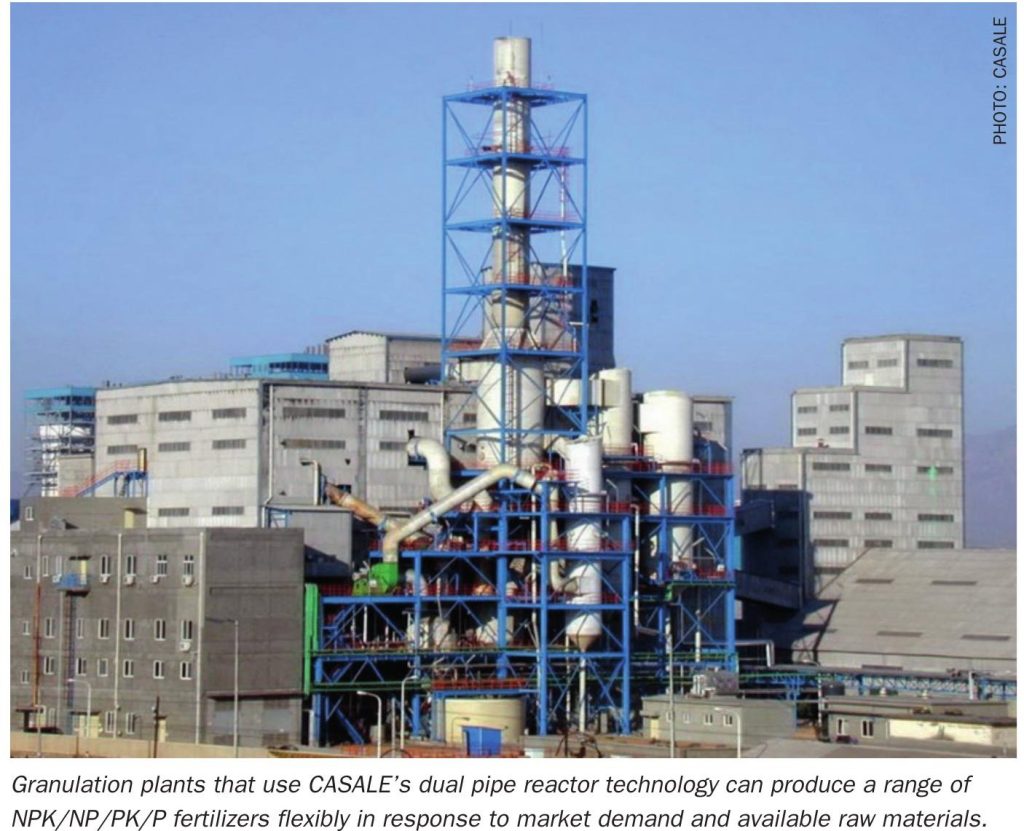
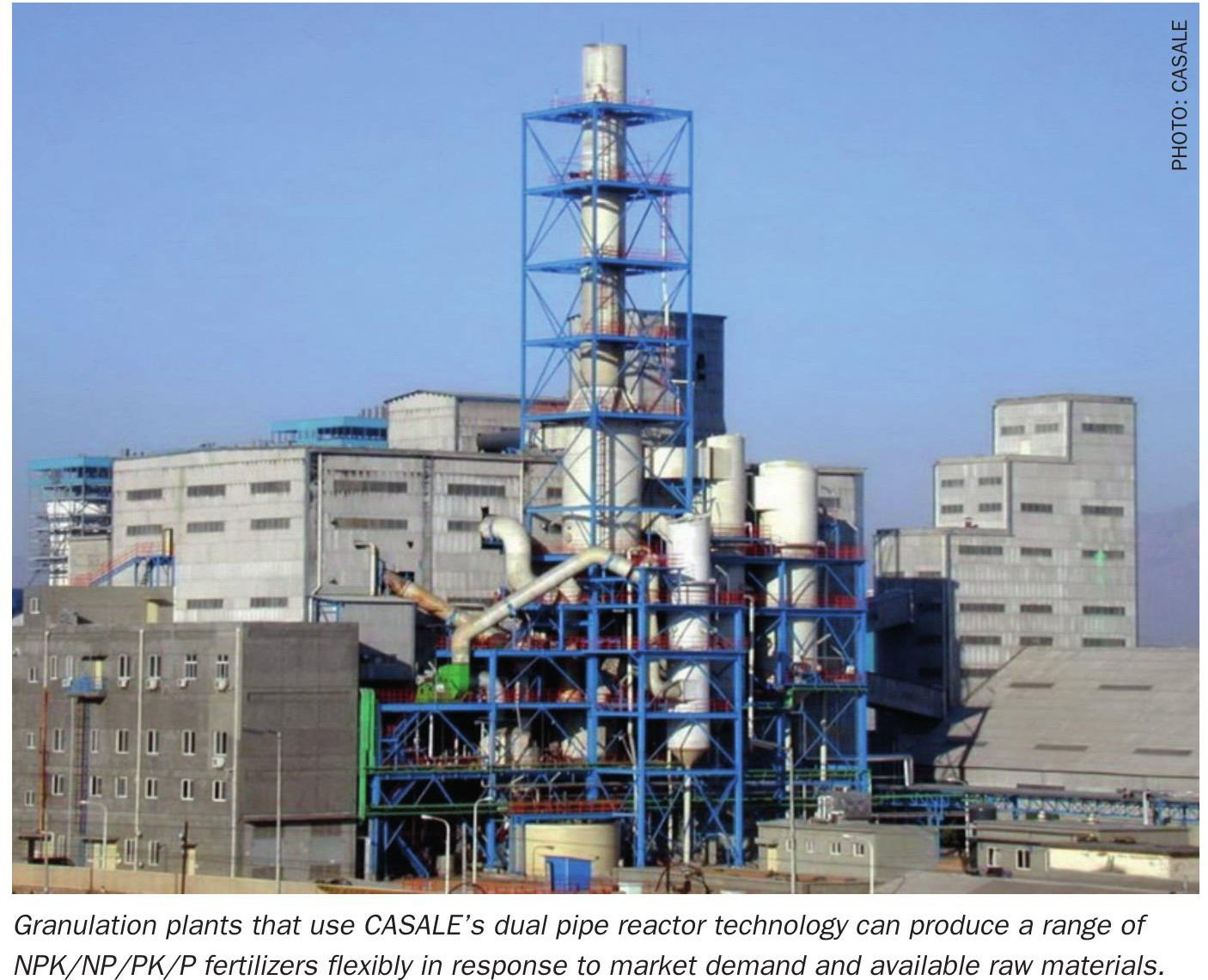
CASALE offers a wide spectrum of granulation technologies for various NPK/NP/PK/P fertilizer types. Gabriele Marcon outlines how an integrated approach to fertilizer production can support global food security – through sustainable, efficient and flexible fertilizer manufacturing.
Introduction
Global demand for fertilizers is expected to steadily increase in future to meet the food needs of the world’s population, which is projected to grow to ten billion by 2050.
Ensuring that fertilizers are affordable and available, while meeting ever higher sustainability requirements, will be essential if agricultural productivity is to continue to improve.
While ammonia and urea will remain key nitrogen sources in agriculture, fertilizer producers are diversifying their product ranges, with a particular focus on the sustainability and environmental impact of crop nutrient products.
CASALE – thanks to its deep ammonia and urea production expertise and its broad portfolio of advanced process technologies – is well positioned to help fertilizer producers improve their competitiveness. The company offers a wide range of production options for various fertilizer types, including:
• Ammonium nitrate-based fertilizers
• Complex fertilizers
• Phosphate fertilizers.
Dual pipe reactor technology
CASALE offers dual pipe reactor technology as a chemical granulation process for NPK production (Figure 1). The dual pipe reactor has distinct advantages over other types of chemical granulation by providing two separate locations for reactions between sulphuric acid/phosphoric acid (H2SO4/H3PO4) and ammonia (NH3) to take place:
• The granulator pipe reactor (GPR)
• The dryer pipe reactor (DPR).
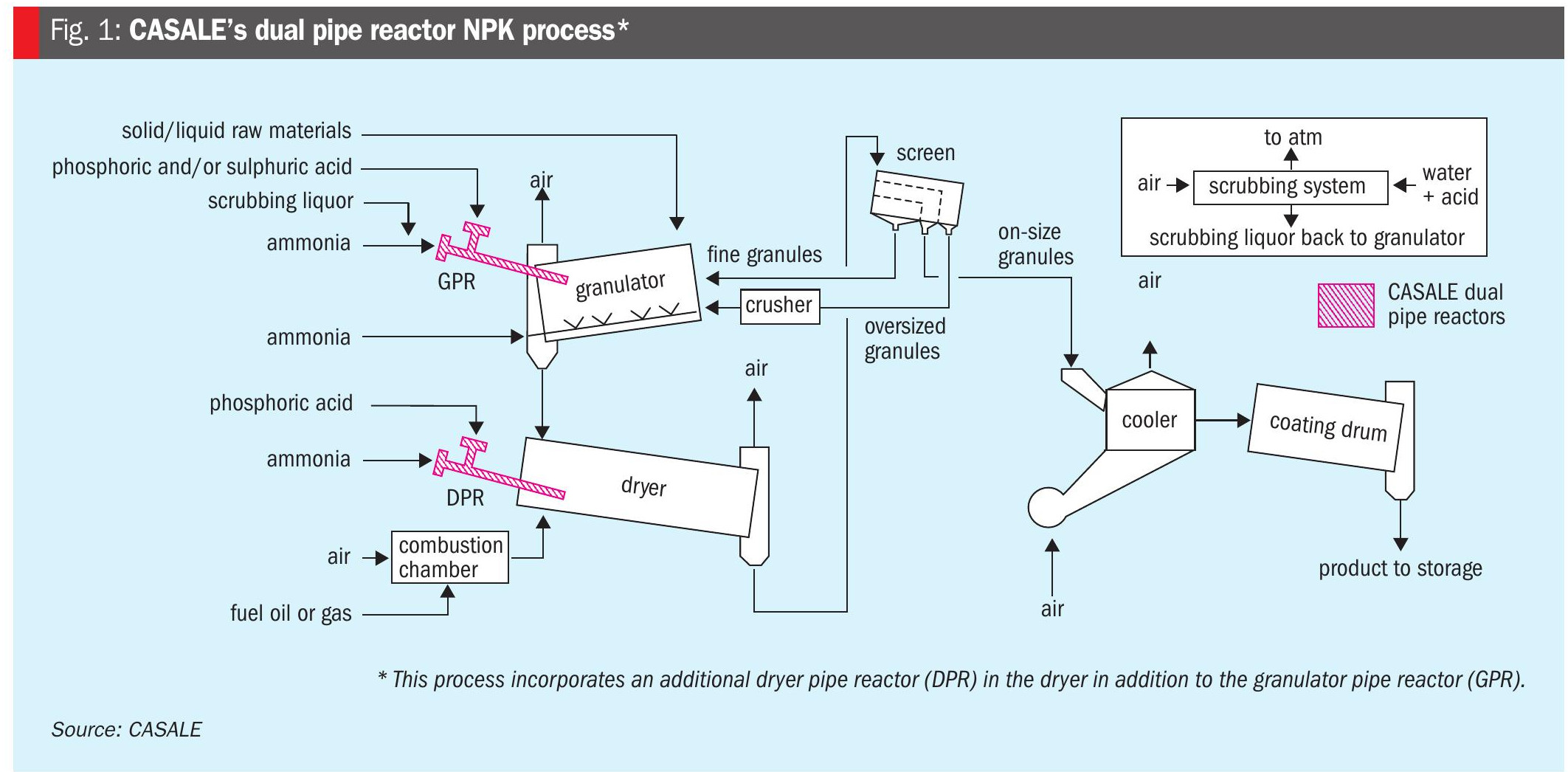
The GPR is located inside the granulator drum. This is supplied with a feed of H3PO4 and/or H2SO4 together with NH3 and recycled scrubbing liquor. The DPR is located inside the dryer drum and is supplied with an H3PO4 and NH3 feed. Acid(s) can also be supplied to the scrubbing system to properly control atmospheric NH3 emissions.
This design configuration makes it possible to widen the range of raw material choices and, consequently, increase the number of NPK grades that can be produced. It also guarantees the lowest possible production cost by adjusting the solid-liquid ratio to lower the recycle rate.
The production of any NPK grade can be targeted by selecting different raw materials such as:
• Solid and liquid ammonium nitrate (AN) and urea
• Liquid (phosphoric acid) or solid (MAP, DAP, SSP, TSP, etc.) phosphorus sources
• Liquid or gaseous ammonia
• Sulphuric acid
• Nitric acid
• Solid ammonium sulphate (AS)
• Elemental sulphur
• Micronutrients.
NPK or NP grades can be produced by either selecting or omitting a potassium source (KCl or K2SO4), respectively. NP and NPK grades using different nitrogen sources, such as ammonium nitrate, urea or ammonium sulphate, can also be manufactured.
For each NPK grade, raw materials are generally selected according to market availability and cost. Operating costs (particularly recycle rate) also have an impact on raw material selection. Plant flexibility, in terms of raw materials, is therefore a key factor when it comes to the competitive production of NPK grades in response to changing market conditions.
Advantages of chemical granulation
Chemical granulation, because it offers numerous options for selecting different raw materials, can produce a very wide range of different NPK grades. Experience has shown that more than 200 NPK grades can be manufactured at a single plant using different liquid and solid raw materials. This is a priceless advantage as it allows NPK plant operators to respond to market demands, such as the availability of raw materials and customer requests for specific NPK grades.
The NPK granules generated also have the best possible chemical and mechanical characteristics. The level of aggregation inside each granule, for example, is excellent due to the strong links between individual components. At the same time, the granules produced have a uniform chemical composition, good roundness and high crushing strength. These characteristics are ideal as they ensure the field spreading of NPK fertilizers delivers the desired mix of nutrients to the soil in a homogeneous and controlled manner.
Steam granulation – suitable for superphosphates
This NPK production method (Figure 2) achieves a specific NPK grade by granulating a ground mixture of solid raw materials in the presence of steam. The addition of steam is used as a ‘glue’ to stick together the different raw material particles. Raw materials need to be pre-ground prior to steam granulation to achieve effective mixing and agglomeration.
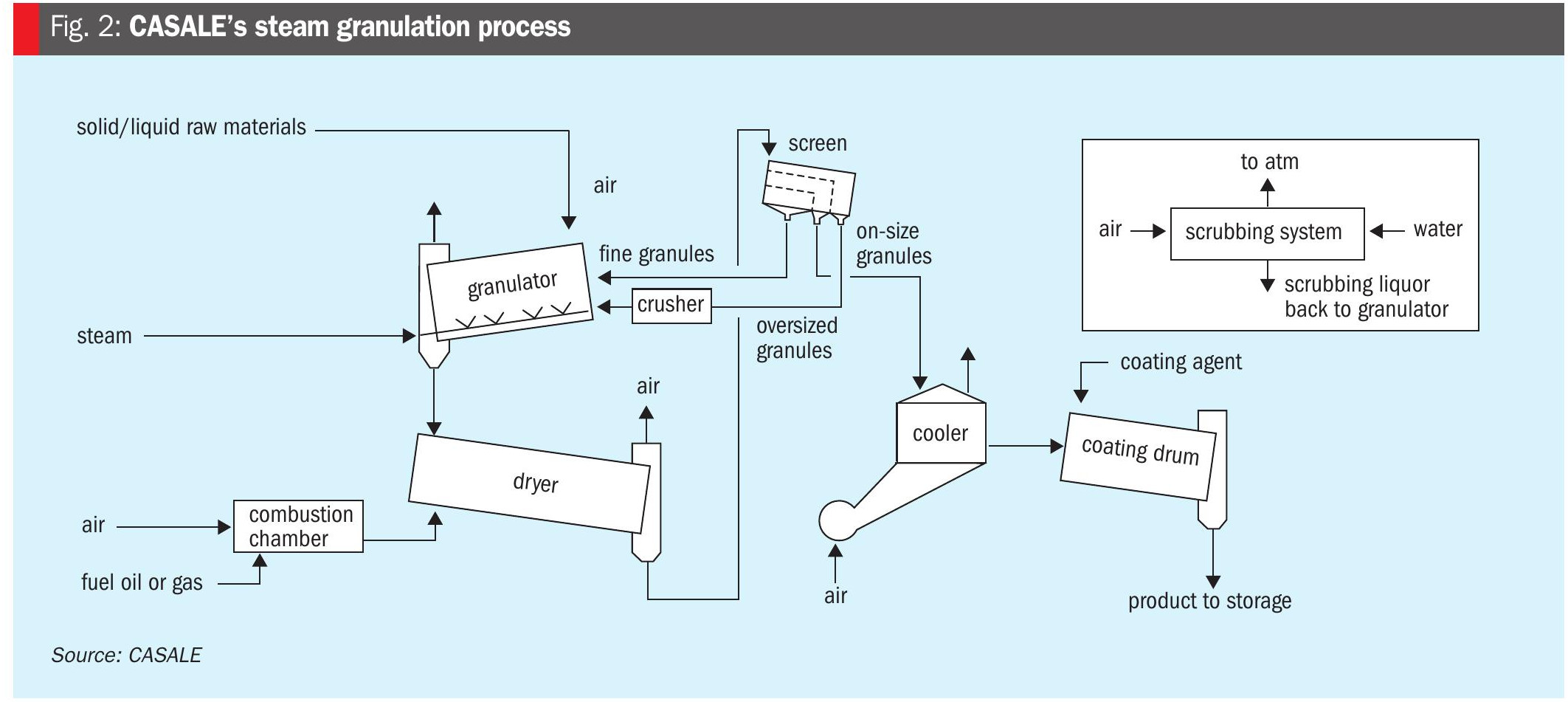
The steam production method, to enable granules to form via agglomeration, must include a full granulation loop (granulator, dryer, screen, crusher, etc). The product granules obtained, although homogeneous in composition, have poor mechanical properties (crushing strength and roundness) because their different components are only held together weakly.
Not all fertilizer raw materials can be mixed and granulated using steam. This limits the flexibility of steam granulation by restricting both the range of acceptable raw materials and the method’s ability to produce different NPK grades.
Despite this, steam granulation still has a deserved place in CASALE’s technology portfolio because of its ability to produce valuable fertilizers, particularly granular phosphates or PK grades, using only solid raw materials. Notable examples include the steam granulation of single superphosphate (SSP) and triple superphosphate (TSP).
In these fertilizer types, the only nutrients present are phosphorus or phosphorus plus potassium, while nitrogen (in the form of ammonia, for example) is specifically avoided. This means that phosphoric acid or sulphuric acid cannot be used, as the ammonia necessary for their neutralisation is absent.
CASALE offers steam granulation as a process step in SSP/TSP production as follows:
• In the first step, SSP/TSP powder is initially produced in a CASALE run-of-pile SSP/TSP plant by acidulating rock phosphate with sulphuric or phosphoric acid.
• In the second step, the SSP/TSP powder, with or without addition of a solid K source such as potassium chloride, is granulated in a steam granulation plant.
The integrated granulation plant
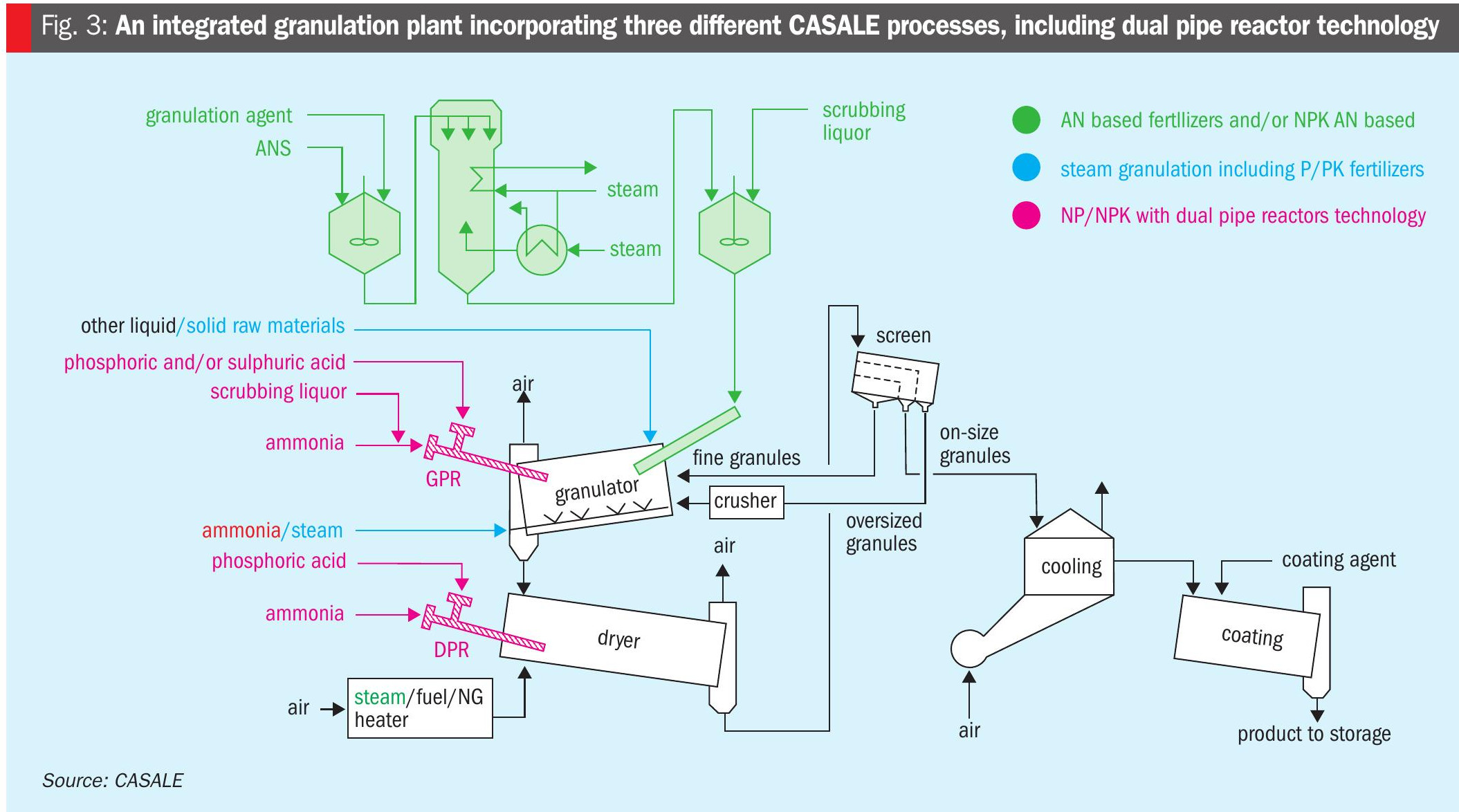
CASALE is a comprehensive licensor of production technologies with wide-ranging expertise and long-standing experience in fertilizer plant design, start-up and operations. By integrating CASALE process technologies (Figure 3), it is possible to design a new granulation plant, or revamp an existing plant, to produce the following fertilizers:
• AN-based fertilizers via chemical granulation
• NP/NPKs via chemical granulation with dual pipe reactor technology
• P/PK fertilizers via steam granulation.
In summary, CASALE can design an efficient, flexible granulation plant able to produce a comprehensive range of NPK/NP/PK/P fertilizers, according to the raw materials available and in response to market demand.
About the author
Gabriele Marcon is Solid Fertilizers Technology Manager at CASALE.
CRU Phosphates+Potash Expoconference 2026
Filippo Davolio, Senior Process Engineer, CASALE, will be presenting on ‘Sustainable Growth in Fertilizer Demand. CASALE’s Recent Acquisitions and Relevant Technological Solutions’ at the conference in Paris on Tuesday 14 April at 16:00–16:30. Register now at: events.crugroup.com/phosphates/register