Fertilizer International 533 Jul-Aug 2026
Energy efficiency in potash drying: a practical guide


PROCESS EFFICIENCY

Energy efficiency in potash drying: a practical guide

As the industry grapples with rising energy costs, potash producers are increasingly focused on mitigating energy leaks and getting the most from their fuel. Whether designing a new rotary dryer or optimising an existing one, producers have several opportunities to maximise both energy and system efficiency. Shane Le Capitaine, Process Sales Engineer, FEECO International, provides a practical guide.

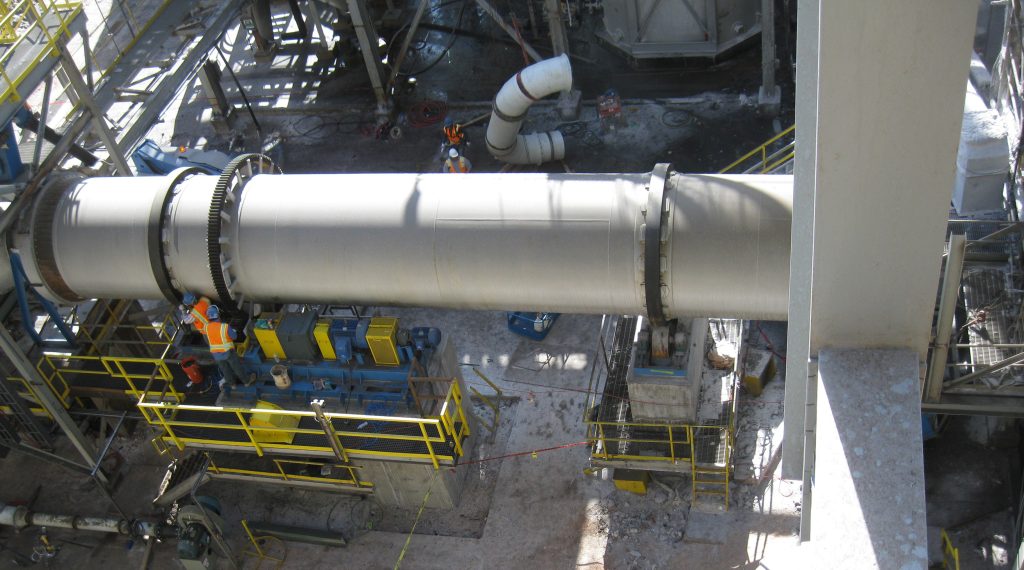
Rotary dryer at a potash plant. PHOTO: FEECO

Drying remains a critical step in producing potash fertilizers that meet market expectations. But it comes at a high cost, representing one of the most significant energy expenses in fertilizer production – sometimes up to 30-40% of a plant’s total energy consumption. This makes drying the single largest thermal load in potash operations.

Designing a new system

Maximising thermal energy efficiency while meeting product moisture targets is the primary objective of designing a new rotary drying system. Design decisions in the following areas contribute to the dryer’s efficiency:

• Fuel selection

• Burner selection

• Combustion chamber

• Waste heat recovery

• Advanced control systems

• Dryer flights.

Fuel selection directly contributes to both thermal efficiency and overall operational efficiency – due to its effects on combustion performance, heat transfer characteristics, and emissions compliance. If available, natural gas offers the highest combustion efficiency, while also delivering the greatest net calorific value per unit of CO2 emitted. Propane offers the next best option for off-grid locations.

Burner selection and design play a critical role in dryer efficiency, both being heavily dependent on fuel choice. Most critically, the amount of excess air the burner requires directly impacts the efficiency of the operation. By reducing excess air from 50% to 15% on a 20 MMBTU/hr dryer, for example, a plant can save roughly 3–5 MMBTU/hr. This corresponds to an annual fuel savings of 26,000-44,000 MMBTU while also reducing carbon emissions.

Other burner qualities also influence efficiency:

• Flame shape dictates the uniformity of heat delivery into the drum

• Turndown ratio governs efficiency during partial-load operation

• Combustion air management controls the fuel-to-air balance.

Advanced features that allow for tight control over combustion – through the use of temperature sensors and oxygen analysers – provide operators with tools to finely tune their system for efficiency.

A well-designed combustion chamber contributes to efficiency by lowering fuel consumption and minimising emissions through complete fuel combustion. As an added benefit, a combustion chamber decreases cooling requirements by preventing contact between the product and flame – ultimately lowering energy costs and emissions.

Where applicable, new systems can also incorporate heat recovery to capture waste heat and divert it to other applications in the plant, reducing total energy demand. When available, waste heat generated elsewhere in the plant can also be recovered and incorporated into the dryer to increase efficiency by preheating the combustion and dilution air. Preheating combustion air using the dryer exhaust, for example, can reduce burner fuel consumption by 5–10% – a retrofit with a typical payback of under two years.

Advanced control systems – as well as enabling start-up and shutdown – can automatically balance inlet temperature, feed rate, and airflow in real time. Compared to manual operator adjustment, this can often reduce energy consumption by 3-7% while maintaining tight product moisture targets.

Dryer flights, also known as material lifters, can significantly influence heat transfer and the system’s thermal efficiency. Flights work by picking up material and dropping it through the stream of combustion gases. This creates a ‘curtain’ of material in the drum’s cross section, which, when designed properly, maximises heat transfer between the material and gases. Both flight design (geometry, pitch) and placement pattern (staggered, spiral, etc.) can be customised, based on the material’s drying behaviour, to maximise heat transfer in the curtain.

Collectively, these essential design decisions – fuel, burner, combustion chamber, flights – have a direct and measurable impact on the dryer’s energy consumption and efficiency.

Optimising an existing system

Plant managers with existing dryer systems often struggle with excess energy consumption, poor heat transfer, and other indications of inefficient or outdated design, but can feel stuck within the confines of their existing system. Through best practices and a few targeted retrofits, however, plant managers can ensure their dryer is performing as efficiently as possible, with many of the principles of new system design applicable. Priorities include:

• Optimising the curtain

• Keeping seals maintained

• Avoiding over-firing

• Tuning the burner

• Minimising start-ups and shutdowns

• Taking advantage of process audits.

Optimising the curtain: As with a new dryer, the flight design and pattern can either contribute to or detract from efficiency. Existing systems are particularly susceptible to inefficiencies. This can be due to worn internals, changes in feedstock or operating parameters, or simply a lack of maintenance.

Worn or missing flights, by creating gaps in the curtain, will reduce efficiency. Additionally a ‘one-size-fits-all’ approach to flight design risks creating an inefficient system from the start. This can be remedied by tailoring flight design to the specific characteristics of the material that influence its drying behaviour – angle of repose, moisture content, etc.

Through material analysis, and sometimes testing, flight design and pattern can be altered to promote more efficient heat transfer. Even modest adjustments, such as replacing worn flights or correcting pitch angle, have been shown to improve heat transfer efficiency by 5-15% in underperforming dryers.

Keeping seals maintained: Dryer seals are an important but often overlooked way of promoting efficient energy use in the plant. Because rotary dryers operate at a negative pressure, seal degradation will allow the ingress of air. By diluting the processing environment, this causes the temperature to drop and the burner to overcompensate.

The costs associated with worn seals can add up quickly: even a small air leak can increase burner fuel consumption by 3–8% as the system works harder to maintain setpoint temperatures. Regular inspection and prompt repair of worn seals is one of the lowest-cost, highest-return energy actions a plant can take.

Avoiding over-firing: A common, but costly approach to drying is to increase the inlet temperature to ensure all material is uniformly dried. While this quickly eliminates under-dried product, it increases energy consumption – and may even cause product degradation.

A dryer that is not yielding uniformly dried material often indicates a mismatch between design and material characteristics. This is particularly likely in settings where feedstock conditions have changed. By making targeted adjustments to operating parameters, such as percent fill, drum speed, feed rate, etc., operators can re-optimise the drum based on feed conditions. This provides a reliable way to ensure consistent drying, without increasing energy costs.

Tuning the burner: Burner performance can degrade over time, as burners experience wear or process conditions change, reducing energy efficiency. Poor performance is often shown by the presence of flame instability, rising stack temperatures despite a constant firing rate, or a gradual increase in fuel consumption when throughput has not changed.

Operators can improve fuel efficiency and reduce wear on the system by re-tuning the burner for existing conditions, including adjusting air levels, fuel-to-air ratio, and confirming proper sensor operation. By adjusting the fuel-to-air ratio to maintain 2-3% excess oxygen in the flue gas, for example, the plant can recover 2-5% of fuel consumption lost to gradual change.

A combustion analysis should be conducted at least annually to verify that combustion efficiency exceeds 99.5%.

Older systems may benefit from the fitting of replacement burners with modern features such as improved turndown ratios, enhanced control, and greater combustion efficiency.

Minimising start-ups and shutdowns: While most potash plants generally run non-stop, it’s important to recognise that start-ups and shutdowns consume more energy and yield higher emissions than steady-state operation.

A single cold start of a mid-sized dryer can consume the energy equivalent of 2–4 hours of normal operation – and is fuel spent without product yield. Every avoided shutdown is energy saved. Maintenance planning and preventive maintenance procedures are therefore important for minimising unexpected downtime.

Plant personnel should regularly inspect the dryer to catch potential issues early. Further, the original equipment manufacturer (OEM) should conduct a dryer inspection annually during planned downtime to thoroughly assess the drum’s mechanical condition both inside and out.

Taking advantage of process audits: In existing systems, identifying the root cause of inefficiency is often challenging, as it may be the result of several factors. Plant managers unsure where to begin – or looking to mitigate inefficiencies as quickly as possible – should have the OEM or other qualified service provider conduct a process audit on the system.

These audits tend to differ, based on the provider, but generally compare original design data with current operating conditions to systematically identify problem areas. Producers who utilise these services often see:

• Improved product quality

• Reduced energy costs

• Increased production

• Minimised downtime

• Lower maintenance costs

• Fewer upsets.

Concluding remarks

The energy costs associated with dryer design and operation provide potash producers with opportunities to eliminate wasted energy in both new and existing systems. From strategic design decisions around fuel, burners, and controls, to targeted maintenance and operational best practices, producers can continue to achieve energy efficiency gains throughout a dryer’s service life.

Those unsure of where to begin should work with a qualified dryer manufacturer or service provider for practical guidance on design and maintenance decisions that mitigate inefficiency.

Latest in Energy Optimisation

The secrets of successful sulphur strategies

Efficient sulphur recovery is essential for modern refineries to meet stringent environmental regulations and support sustainability goals. Fluor examines the key design considerations, smart design strategies and flexible sulphur block configurations that are essential in achieving an overall optimised design. Together, these strategies enhance efficiency, reduce emissions, improve reliability, and provide flexibility for changing crude qualities, ensuring compliant and economically robust refinery operations.